
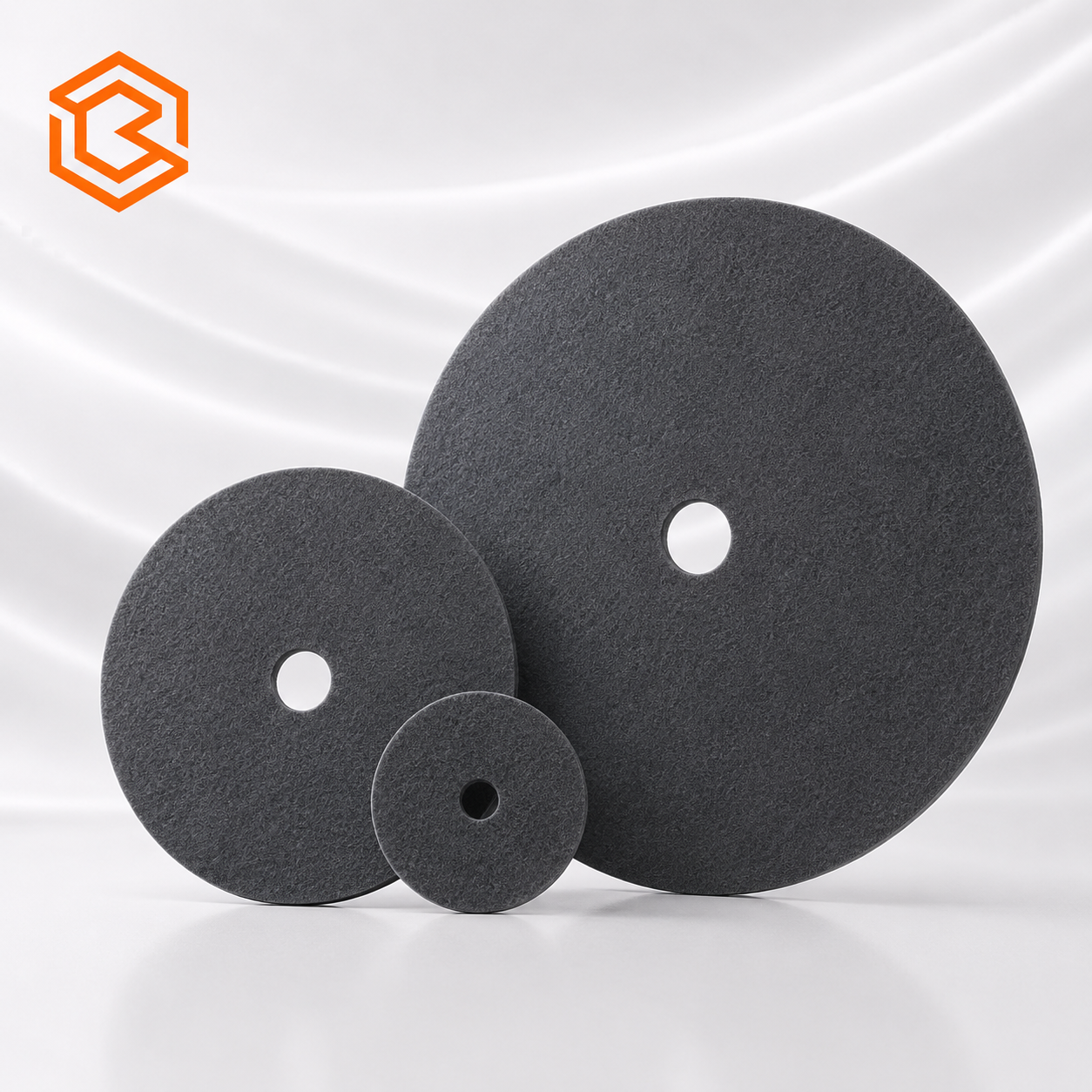
Activated carbon pad
BK 01
- Thickness
- 2 mm
- Grammage
- 800 g/m2
- Porosity
- 12 sec
- B.F.
- 8 kg/cm2
Adsorptive media
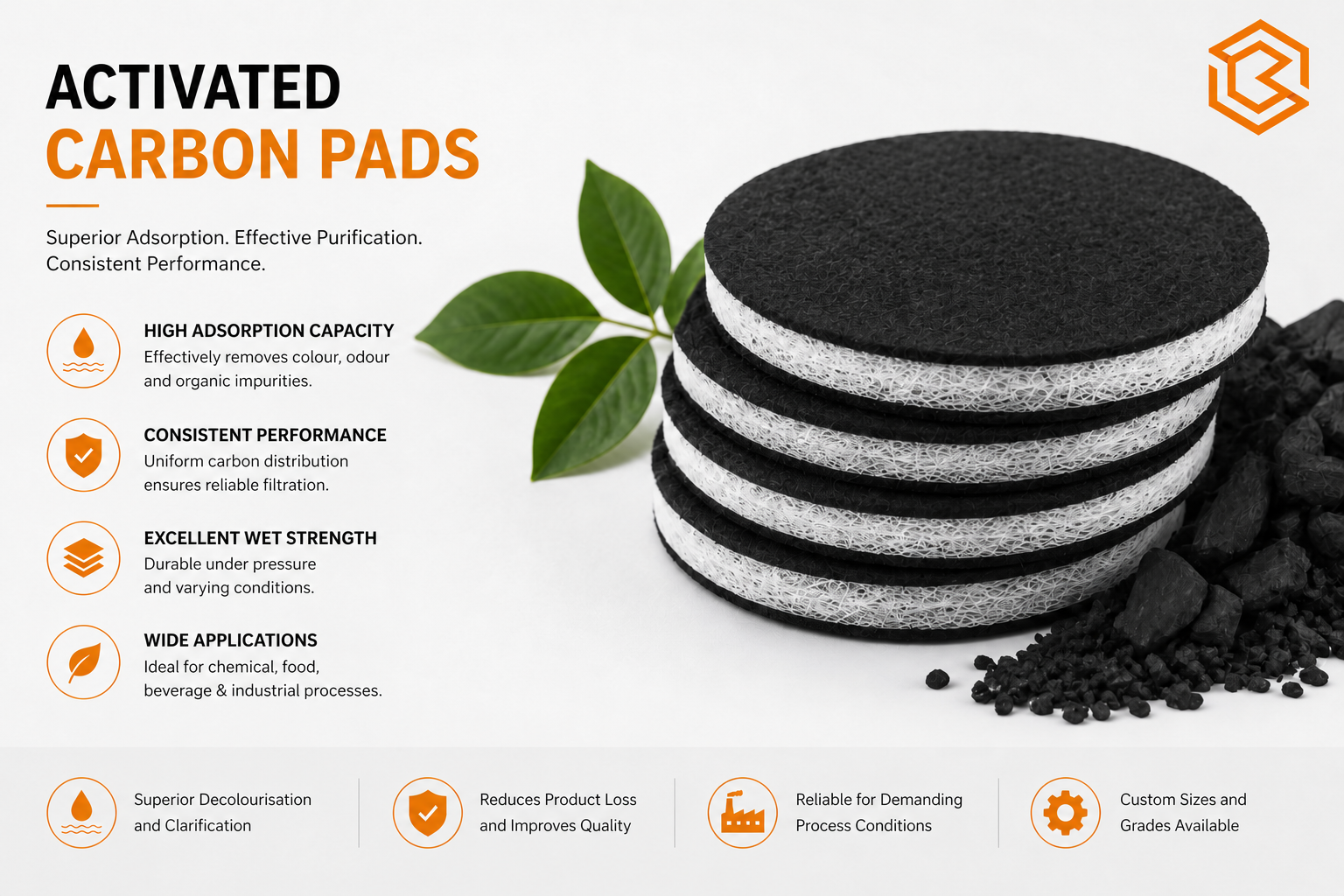
We manufacture activated carbon-impregnated filter pads for processes that benefit from contained adsorption and particulate retention in a single supported medium.
Sri Bharathi Tech manufactures and supplies Activated Carbon Filter Pads from Ankleshwar, Gujarat, India, with grade, size and configuration selection based on the buyer’s process and equipment.
Technical product information
Activated carbon in a supported filter pad, combining adsorption and particulate retention for compatible process liquids.
In suitable plate-and-frame applications, carbon-impregnated pads can replace loose-carbon dosing and subsequent powder removal.
Activated carbon pad
Operating principle
An activated carbon filter pad incorporates adsorptive carbon within a supported filter matrix. As a compatible liquid passes through the pad, suspended particles can be retained by the media while selected dissolved colour- or odour-causing compounds may adsorb onto available carbon surface.
This replaces two separate operations in some plate-and-frame or supported-pad processes: dosing loose powdered carbon into a tank and subsequently removing that powder on paper or cloth. Adsorption capacity is finite, so colour or odour breakthrough—not only differential pressure—can determine the endpoint.
Media design
Sri Bharathi offers carbon-impregnated pads made with different activated-carbon grades to help optimise the filtration duty. The detailed carbon type, loading, binder or support chemistry, dimensions and extractables profile are grade-specific and should be requested before trial.
Because adsorption is molecule-specific, an activated carbon pad cannot be selected solely by particle-retention language. Contact time, concentration, temperature, pH, competing organics, flow and carbon accessibility all influence treatment performance.
What to evaluate
01
Combines particulate retention with carbon-based reduction of selected dissolved compounds.
02
Can reduce loose-carbon dosing and the downstream task of capturing carbon powder.
03
Pad form may reduce dust, tank clean-up and carbon scraping in compatible equipment.
04
Different carbon grades are available for optimisation with specific liquids.
05
Colour, odour or analytical endpoint can be trended during a qualification run.
06
Dimensions should match the filter support and seal geometry to prevent bypass.
Technical presentation
The Filter Paper & Pad Deep Dive includes media construction, pad grades and a dedicated activated carbon pad overview. The inline viewer opens directly on the activated carbon pad section.
Technical data
The specifications below provide a practical basis for product selection. Final grade and configuration are matched to the intended process conditions.
| Selection parameter | Product details | Engineering relevance |
|---|---|---|
| Functional component | Activated carbon incorporated in a filter pad. | Provides finite adsorption sites for compatible target compounds. |
| Carbon grade / loading | Grade-specific; request declared information. | Drives adsorption behaviour, capacity and potential extractables. |
| Retention | Depends on the supporting media and process. | Do not assume adsorption performance equals a particulate micron rating. |
| Dimensions | Made for compatible supported-pad or plate-and-frame equipment. | Fit and sealing are essential to avoid untreated bypass. |
| Operating conditions | Fluid-, carbon- and support-specific. | Confirm pH, solvent, temperature and differential-pressure compatibility. |
| Endpoint | Breakthrough, pressure limit, batch volume or quality criterion. | Adsorption can exhaust even when the pad is not hydraulically blocked. |
Process fit
Activated carbon pads may be considered where colour, odour or trace organic reduction is needed alongside clarification in compatible chemical, beverage, food and process-liquid duties. Suitability depends on whether the target compound adsorbs effectively and whether the pad materials meet product-contact requirements.
Questions engineers ask
Not exactly. Carbon dose, accessible surface area, contact pattern and residence time differ. A side-by-side process trial is needed.
No. Adsorption is selective and affected by molecular size, polarity, pH, temperature and competing substances.
Use an agreed outlet-quality or breakthrough limit, together with pressure and throughput criteria. Pressure alone may not reveal exhausted adsorption capacity.
It can combine functions in some systems, but a polishing filter may still be required depending on fines control and final cleanliness.
Continue specifying
Application support
Share your fluid, temperature, desired clarity, existing equipment and dimensions. Our team can then recommend a suitable construction and prepare a quotation.