
01
Hot-service range
The product range covers 180–250 °C for compatible liquids and chemicals.
Hot-process filtration
We manufacture heat-resistant depth filter pads for particulate removal from hot cooking oils and other compatible liquids, with an operating range of 180–250 °C.
Sri Bharathi Tech manufactures and supplies High-Temperature Filter Pads from Ankleshwar, Gujarat, India, with grade, size and configuration selection based on the buyer’s process and equipment.
Operating principle
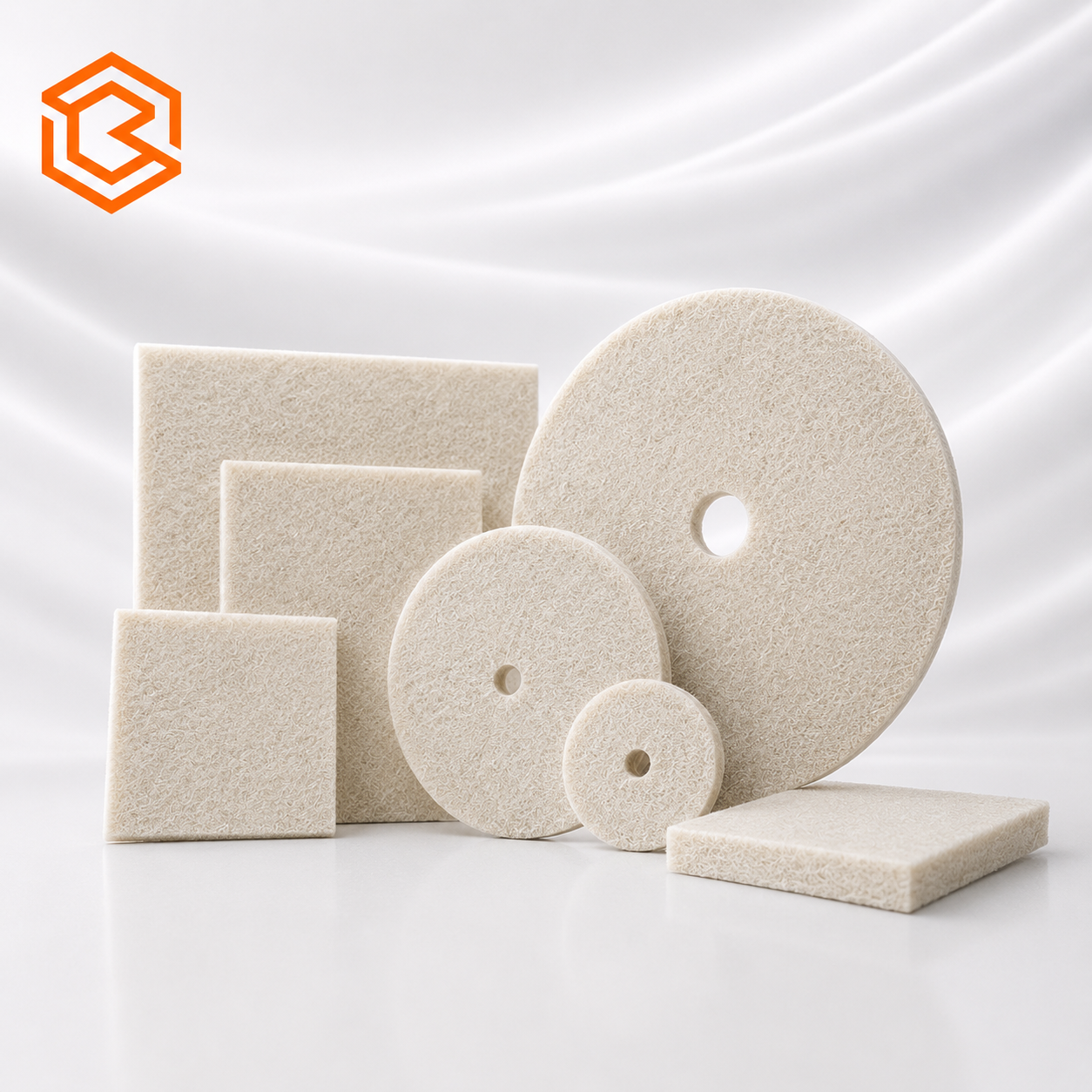
High-temperature filter pads provide a porous depth medium for removing particulate matter from hot, compatible liquids. In frying-oil service, circulation through supported media retains suspended crumbs and degradation solids that would otherwise remain in the oil.
The operating-temperature range is 180–250 °C for this product family. That range does not replace confirmation of the precise grade, support arrangement, exposure time, pressure and fluid chemistry for each installation.
Media design
These heat-resistant depth-filtration media are available in various dimensions for demanding hot-process duties. Grade-specific construction and documentation are provided during technical selection.
At elevated temperature, dimensional stability, seal integrity, oxidation, pressure drop and safe handling become as important as particle retention. The filter assembly, piping, pump, valves and operator procedure must all be rated for the process.
What to evaluate
01
The product range covers 180–250 °C for compatible liquids and chemicals.
02
A porous structure captures suspended material through the media thickness.
03
Designed for particulate filtration of oil used in frying processes.
04
Various sizes are available, subject to equipment and support review.
05
Removing suspended fatty or food residues can support oil-management procedures.
06
Grade-specific composition and limits should be approved before hot operation.
Technical data
The specifications below provide a practical basis for product selection. Final grade and configuration are matched to the intended process conditions.
| Selection parameter | Product details | Engineering relevance |
|---|---|---|
| Temperature range | 180–250 °C. | Confirm continuous versus intermittent exposure and actual grade limit. |
| Duty | Hot edible cooking oils and other compatible liquids/chemicals. | Fluid compatibility must be verified; the range is not universal permission. |
| Filtration mode | Depth filtration. | Supports solids capture within the medium and at the developing cake. |
| Dimensions | Various; provide equipment drawing or pad sample. | Correct support and sealing are critical at elevated temperature. |
| Material composition | Available for the selected grade. | Request a grade-specific technical data sheet before approval. |
| Change-out | Based on pressure/flow, clarity and safe operating procedure. | Hot-media handling requires a controlled cool-down and disposal method. |
Process fit
The primary application is particulate removal from hot cooking oils used in frying, including hotels, restaurants and the wider food industry. Other hot liquids or chemicals require an explicit compatibility review because temperature resistance alone does not establish chemical suitability.
Questions engineers ask
Do not assume so. Use only a grade whose supplier has confirmed the construction and limit for the intended exposure.
No. This is the product-family operating range. Chemical compatibility, pressure, exposure duration, supports and safety controls remain application-specific.
Track flow or pressure together with visible solids, oil-quality indicators and the site operating procedure. Avoid relying on appearance alone.
Food-contact suitability is grade-specific. The required documentation can be provided for the intended jurisdiction and conditions of use.
Continue specifying
Application support
Share your fluid, temperature, desired clarity, existing equipment and dimensions. Our team can then recommend a suitable construction and prepare a quotation.