
01
Inherently hydrophobic membrane
Resists water intrusion while allowing dry air and process gases to pass.
Critical membrane filtration
We manufacture hydrophobic expanded-PTFE membrane cartridges for gas and vent filtration, compatible aggressive chemicals and demanding pharmaceutical processes.
Sri Bharathi Tech manufactures and supplies PTFE Membrane Filter Cartridges from Ankleshwar, Gujarat, India, with grade, size and configuration selection based on the buyer’s process and equipment.
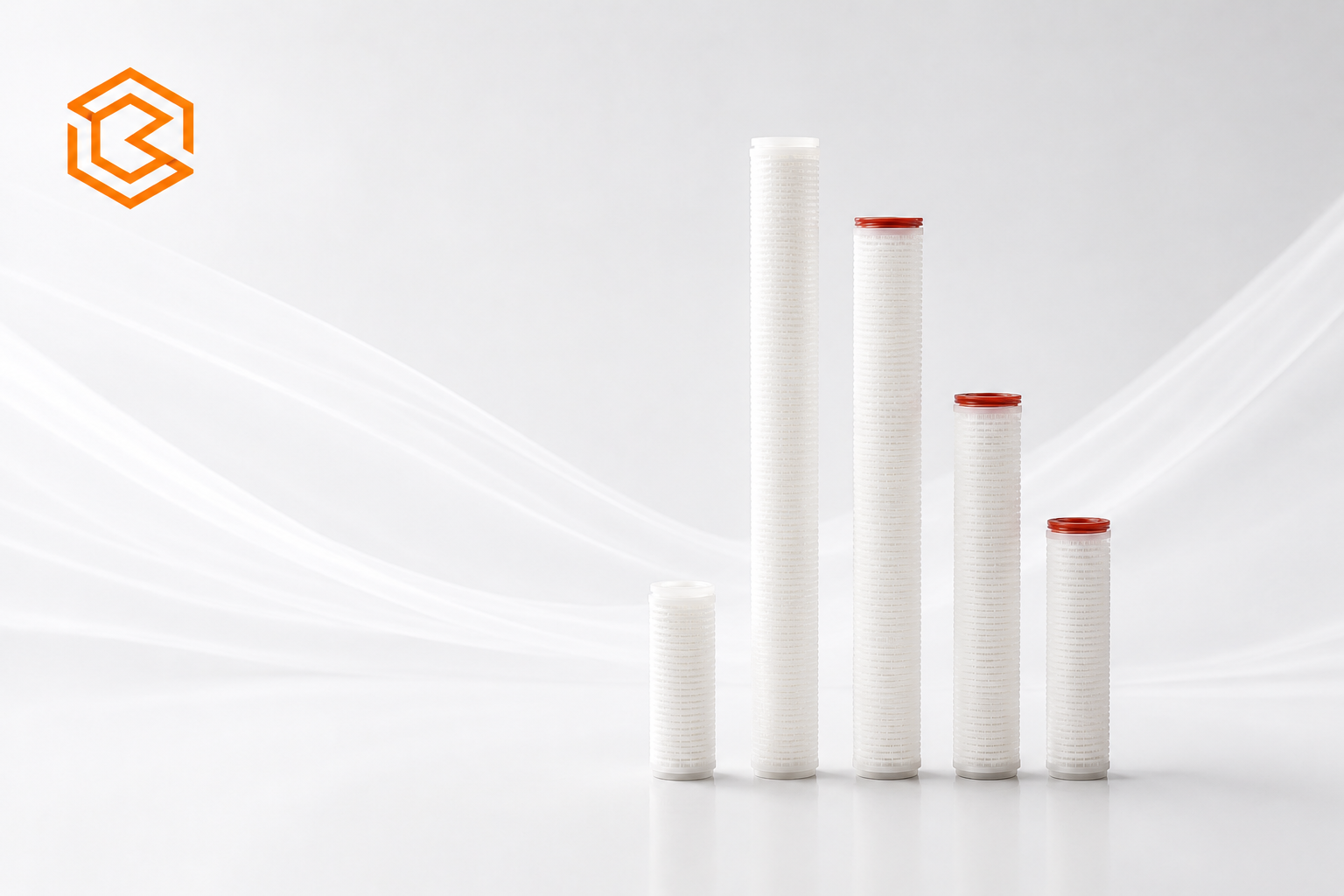
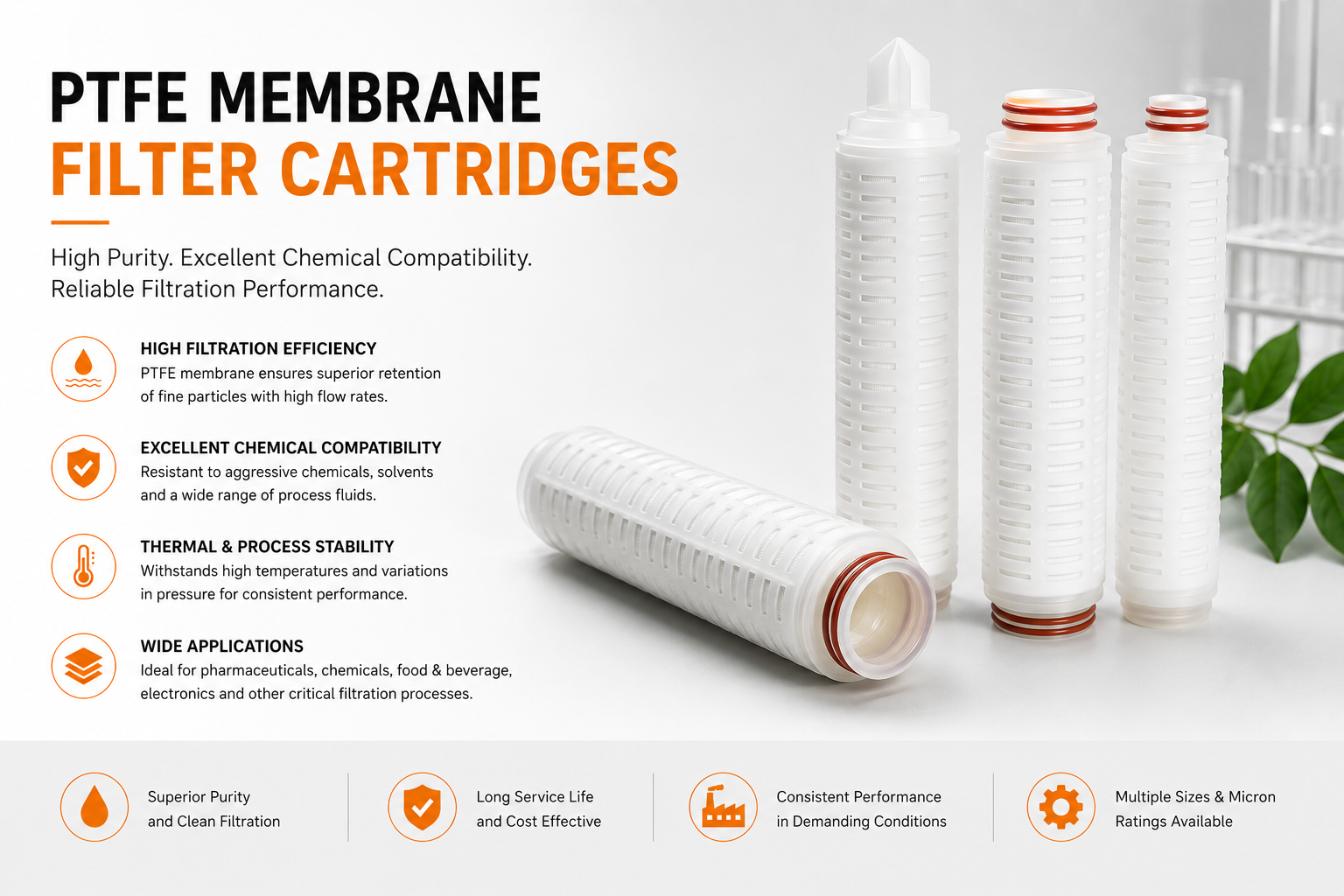
Operating principle
A PTFE membrane cartridge uses a thin, microporous expanded-polytetrafluoroethylene layer as the retention barrier. The membrane is inherently hydrophobic: dry pores readily pass air and process gases while resisting liquid-water intrusion. That behaviour makes PTFE especially useful for sterile venting, compressed-gas filtration and tank breathing duties.
For compatible chemical liquids, the membrane can be pre-wetted with a suitable low-surface-tension fluid before aqueous service. In normal outside-to-inside flow, the pleated pack provides useful membrane area and directs filtrate or clean gas through the polypropylene core.
Media design
The cartridge combines an expanded PTFE membrane with polypropylene support layers, inner core, end caps and outer cage. This construction protects the membrane and provides a cost-conscious alternative to an all-fluoropolymer element where polypropylene is compatible with the process.
All wetted materials must be checked—not only PTFE. Select Buna-N, EPDM, silicone, Viton or FEP-encapsulated Viton O-rings around the chemical, temperature, steam exposure and extractables requirements of the actual duty.
What to evaluate
01
Resists water intrusion while allowing dry air and process gases to pass.
02
PTFE is suited to many aggressive chemicals and solvents, subject to full-cartridge compatibility.
03
Available pore-size options support fine gas, vent and compatible liquid-filtration duties.
04
A 10-inch element provides 0.79 m² of membrane area.
05
Grade-specific diffusion values can support installation and routine integrity procedures.
06
The construction is designed for repeated steam or autoclave exposure.
Technical data
The specifications below provide a practical basis for product selection. Final grade and configuration are matched to the intended process conditions.
| Selection parameter | Product details | Engineering relevance |
|---|---|---|
| Membrane | Expanded PTFE. | Provides the hydrophobic retention surface; request grade-specific validation. |
| Support and hardware | Polypropylene support layers, core, end caps and cage. | Confirm compatibility for the full fluid composition and exposure time. |
| Pore sizes | 0.1, 0.2, 0.45 and 1.0 µm. | Match pore size to the retention objective and required validation method. |
| Nominal lengths | 5, 9.75, 20, 30 and 40 inches. | Confirm effective length and stacking arrangement against the housing. |
| Diameters | 69 mm OD; 25.4 mm ID. | Verify housing clearance, socket geometry and support fit. |
| Membrane area | 0.79 m² per 10-inch element. | Area influences clean pressure drop and gas or liquid throughput. |
| Maximum forward differential pressure | 5.2 bar at 21°C; 2.8 bar at 80°C; 1.03 bar at 95°C. | The allowable pressure decreases as temperature rises. |
| Maximum reverse differential pressure | 2.8 bar at 21°C. | Reverse flow and integrity-test procedures must remain within the quoted limit. |
| O-ring options | Buna-N, EPDM, silicone, Viton and FEP-encapsulated Viton. | Seal chemistry can determine compatibility and extractables performance. |
Process fit
PTFE membrane cartridges are well suited to sterile tank vents, fermenter and bioreactor vents, compressed air and process gases, solvent filtration, aggressive chemicals and compatible pharmaceutical or beverage duties. Hydrophobicity helps protect gas systems from accidental wetting and supports rapid recovery after steam cycles when the membrane is properly drained and dried.
Questions engineers ask
Its inherent hydrophobicity helps resist liquid-water penetration while the dry porous membrane passes air or gas. The selected grade still needs a defined retention claim and integrity method.
It can after complete pre-wetting with a compatible low-surface-tension fluid and a controlled exchange into the process liquid. Poor wetting can cause high pressure drop or incomplete use of the membrane area.
No. Sterilising-grade use requires grade-specific microbial-retention validation, an appropriate installation, integrity testing and a controlled process.
Confirm cartridge configuration, seals, temperature, differential pressure, cycle time, drainage and the approved number of cycles for the exact grade.
PTFE may tolerate a fluid that the support layers, cage, core or O-rings do not. Compatibility must cover every wetted component at the operating concentration and temperature.
Continue specifying
Application support
Share your fluid, temperature, desired clarity, existing equipment and dimensions. Our team can then recommend a suitable construction and prepare a quotation.