
01
High-temperature resistance
Metallic construction extends use beyond many polymer media limits.
Metal filter elements
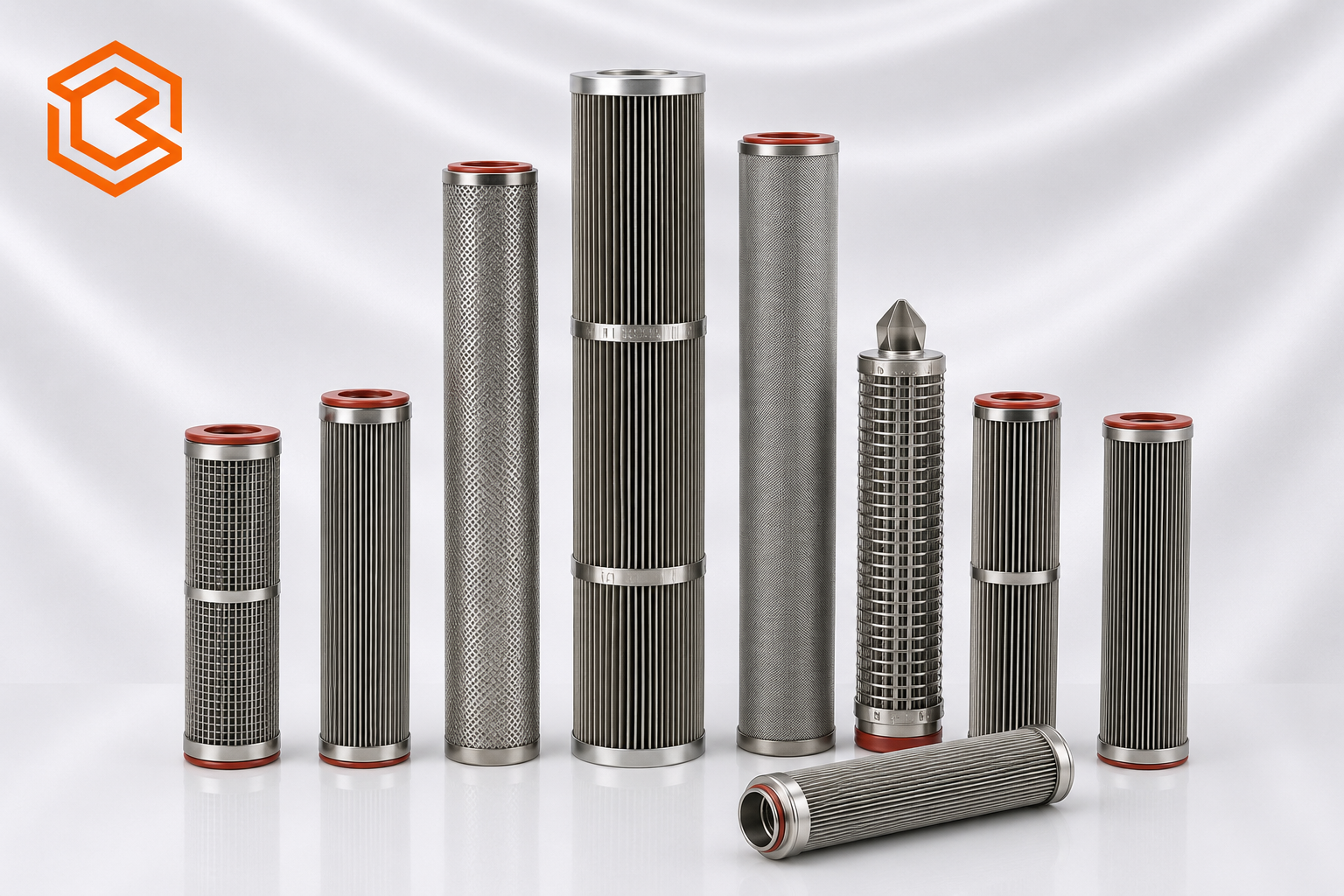
We manufacture reusable metallic filter cartridges for high-temperature, high-differential-pressure and chemically demanding duties where polymer media may be unsuitable.
Sri Bharathi Tech manufactures and supplies Stainless-Steel Filter Cartridges from Ankleshwar, Gujarat, India, with grade, size and configuration selection based on the buyer’s process and equipment.
Operating principle
Stainless-steel filter elements use stable metallic pores to retain particles while allowing fluid to pass. Cylindrical designs provide a simple robust surface; pleated designs increase area. Sintered mesh or random-fibre constructions bond contact points to stabilise the porous structure.
These elements are selected when temperature, differential pressure, chemical exposure, backflushing or reuse exceeds the practical limits of many polymer or fabric media. Performance still depends on pore construction, alloy, support layers and housing sealing.
Media design
Sri Bharathi offers stainless-steel wire mesh, sintered metal, random-fibre and sintered-fibre media in cylindrical or pleated configurations. Standard alloy options include SS 304 and SS 316; SS 316L can be specified where required.
Coarser support media can protect the primary filter layer. Bubble-point testing can identify openings larger than the specified pore size in joints or seams.
What to evaluate
01
Metallic construction extends use beyond many polymer media limits.
02
Supported mesh and sintered structures can withstand demanding service.
03
Elements may be cleaned or backflushed using a validated procedure.
04
Sintered constructions are designed to preserve pore structure.
05
Metallic media avoid polymer or textile-fibre shedding.
06
Available forms include tubes, cartridges, discs, plain cylinders and pleated elements.
Technical data
The specifications below provide a practical basis for product selection. Final grade and configuration are matched to the intended process conditions.
| Selection parameter | Product details | Engineering relevance |
|---|---|---|
| Alloy options | SS 304 and SS 316. | Confirm exact grade, certificate and corrosion compatibility. |
| Media types | Wire mesh, sintered metal, random fibre and sintered metal fibre. | Construction determines pore stability, cleanability and pressure drop. |
| Lengths | 10, 20, 30 and 40 inches; custom sizes available. | Match housing and support requirements. |
| Micron options | 0.5, 1, 3, 5, 10, 20, 25, 50 µm and more. | Confirm test method and pore/rating definition. |
| Diameters | 64 mm OD; 28 mm ID. | Verify housing clearance. |
| Connections | DOE, 226, 222 and 1-inch NPT/BSP. | Match socket, thread and seal design. |
| Integrity test | Bubble-point testing is available. | Agree test fluid, method and acceptance criterion. |
Process fit
Applications include catalyst recovery, polymer filtration, cross-flow and gas filtration, analytical and medical devices, oil filtration, hot-gas filtration, aerosols, fuel and hydraulic oils, gas-liquid separation and RO pre-filtration.
A reusable element needs a controlled cleaning method matched to the contaminant and metallurgy. Define maximum backflush pressure, cleaning chemistry, temperature, drying, inspection, integrity test and retirement criteria. Reuse should be based on restored flow and verified integrity—not appearance alone.
Questions engineers ask
No. Alloy selection must consider chlorides, acids, alkalis, temperature and crevice conditions. Request the exact metallurgy.
With a suitable wetting liquid, it can indicate the largest effective pore or reveal oversized defects in seams and joints under a defined method.
Pleating increases area within a given envelope, potentially reducing clean pressure drop and extending the cycle, but it can complicate cleaning.
Only if the exact alloy, seals, joints and construction are rated for the temperature, pressure and repeated cycles.
Continue specifying
Application support
Share your fluid, temperature, desired clarity, existing equipment and dimensions. Our team can then recommend a suitable construction and prepare a quotation.