
01
Depth-loading fibre matrix
Particles can be retained through the sheet thickness instead of only at a single surface.
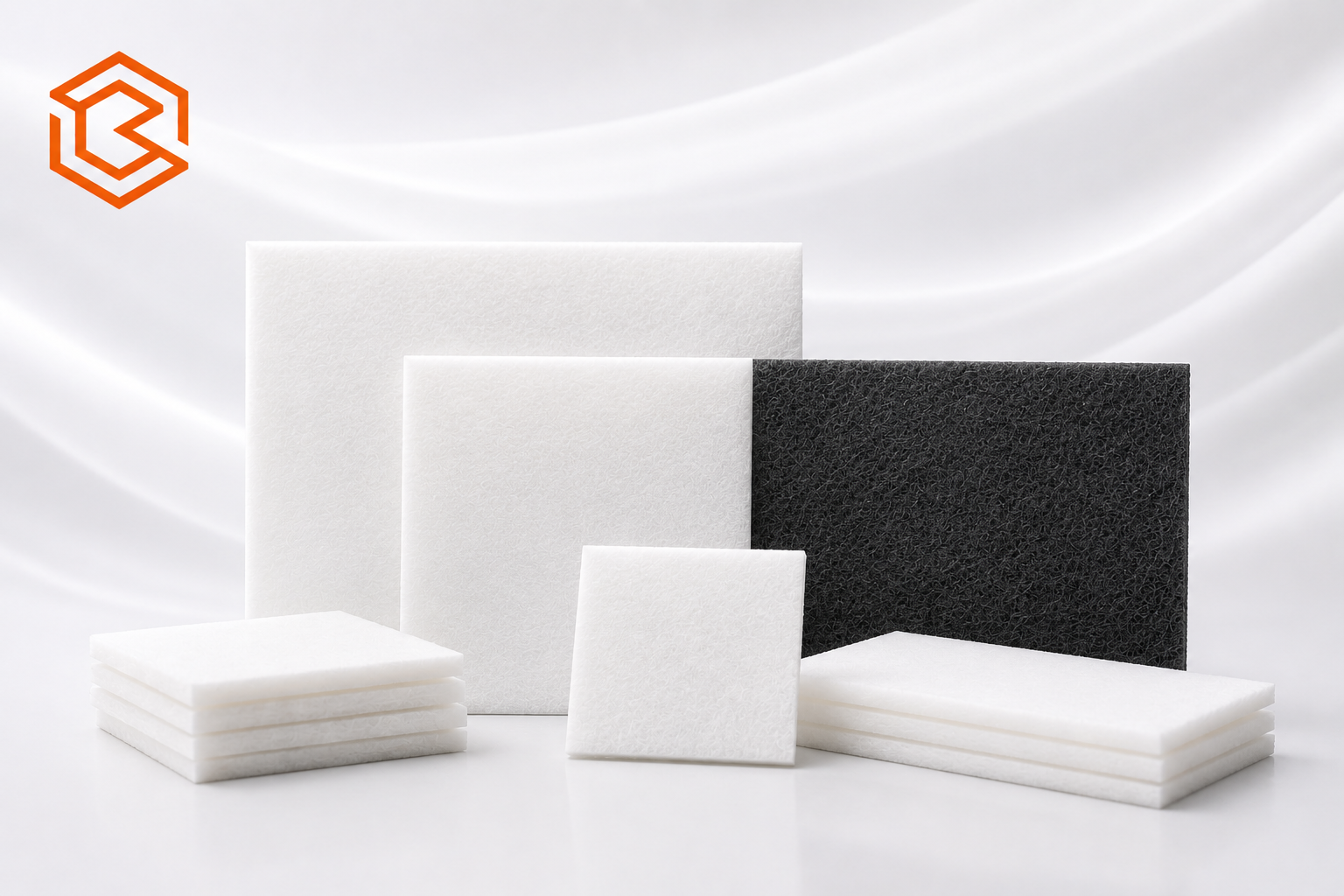
Filter pads
Virgin-pulp depth media for rough filtration, clarification, polishing and fine filtration, manufactured with monitored formation and media properties.

Original product references
These first-party Sri Bharathi images are retained from the previous website. Grade tables are legacy published references; confirm current availability, tolerances and test methods with the quotation.


Operating principle
Pulp filter pads use a formed fibre network as a depth-filtration bed. Larger particles are intercepted near the upstream side while smaller particles follow tortuous paths into the sheet and are retained by mechanical interception and process-dependent interactions with the fibre matrix. A surface cake may contribute additional retention as the run proceeds.
Sri Bharathi groups its published pulp-pad range by rough or normal filtration, clarifying and polishing duties, and fine or premium filtration. Those descriptions are functional categories—not interchangeable micron claims. A trial should confirm clarity, throughput and pressure rise with the intended fluid.
Media design
Published Sri Bharathi information describes virgin, unbleached pulp raw material and automated manufacture from pulping through finished media, with reduced direct handling. Existing company materials also reference wood pulp, cotton pulp and hybrid pulp constructions. Raw material and finished-media controls include filtration efficiency, pad porosity, absorbency, filtration speed and bursting factor.
Applicable fibres receive a porous, chemically inert wet-strength impregnation to improve mechanical strength in aqueous filtration. The exact furnish, impregnation and food-contact documentation must be confirmed for the ordered grade.
Alpha cellulose describes the relatively high-molecular-weight cellulose fraction that remains insoluble under a defined alkali test. It can be relevant to consistency, extractables and sensitive-use assessment. No public grade document was found that verifies 90% or 98% values for Sri Bharathi media, so those figures require written grade-specific confirmation before use.
What to evaluate
01
Particles can be retained through the sheet thickness instead of only at a single surface.
02
Published categories cover rough, normal, clarifying, polishing, fine and premium duties.
03
Porosity, absorbency, filtration speed, efficiency and bursting factor are listed process controls.
04
Applicable grades are impregnated to improve mechanical integrity during aqueous filtration.
05
On-demand specification is referenced, subject to technical and manufacturing review.
06
Dimensions and openings can be matched to supported filtration equipment.
Technical data
Values below are limited to information published by Sri Bharathi. Final grade, compatibility and operating limits must be confirmed against the actual process.
| Selection parameter | Available / verified information | Engineering relevance |
|---|---|---|
| Raw material | Virgin, unbleached pulp is stated on the current product page. | Confirm furnish and contact documentation for the ordered grade. |
| Fibre options | Wood pulp, cotton pulp and hybrid pulp are referenced in company materials. | Furnish influences formation, strength and process compatibility. |
| Filtration category | Rough/normal, clarifying/polishing, fine/premium. | Use as a starting point; approve final performance by trial. |
| Thickness / GSM | Legacy MMC guide: 0.5–2.5 mm and 250–1050 GSM; legacy MMCR guide: 1–3 mm and 500–1300 GSM. | Confirm current grade, nominal value, tolerance and test method. |
| Porosity / filtration speed | Monitored parameters; grade values available through technical enquiry. | Influence pressure drop, throughput and cycle length. |
| Strength | Bursting factor monitored; applicable grades use wet-strength treatment. | Important for saturated handling and supported pressure filtration. |
| Alpha cellulose | Grade-specific documentation required; 90%/98% not publicly verified. | Relevant to purity assessment but not a stand-alone retention rating. |
Process fit
Pulp pads can be evaluated for pharmaceutical intermediates, chemicals, cosmetics, beverages, food-process liquids, gelatin and compatible edible-oil duties. Selection changes with clarification stage: an open precoat or rough grade may protect a finer polishing grade, while a denser final pad may be used when incoming solids have already been reduced.
Questions engineers ask
They are related cellulose media, but pads are typically thicker depth structures while papers may be thinner and used for fast or coarse filtration. The tested grade and equipment define the duty.
No. Cellulose purity concerns material composition; retention also depends on fibre geometry, sheet formation, density, thickness, porosity and operating conditions.
A finer or denser pad may blind sooner when upstream solids loading is high. Staged filtration or preclarification can improve the final polishing cycle.
Provide a dimensioned drawing, equipment details, current sample if available, process conditions and required acceptance documents.
Continue specifying
Application support
Share your fluid, temperature, desired clarity, existing equipment and dimensions. Our team can then recommend a suitable construction and prepare a quotation.