
01
100% polypropylene
Broadly compatible material for many aqueous and chemical duties.
Filter cartridges
We manufacture binder-free polypropylene depth cartridges with a progressive outside-to-inside structure for contaminant capacity and general process pre-filtration.
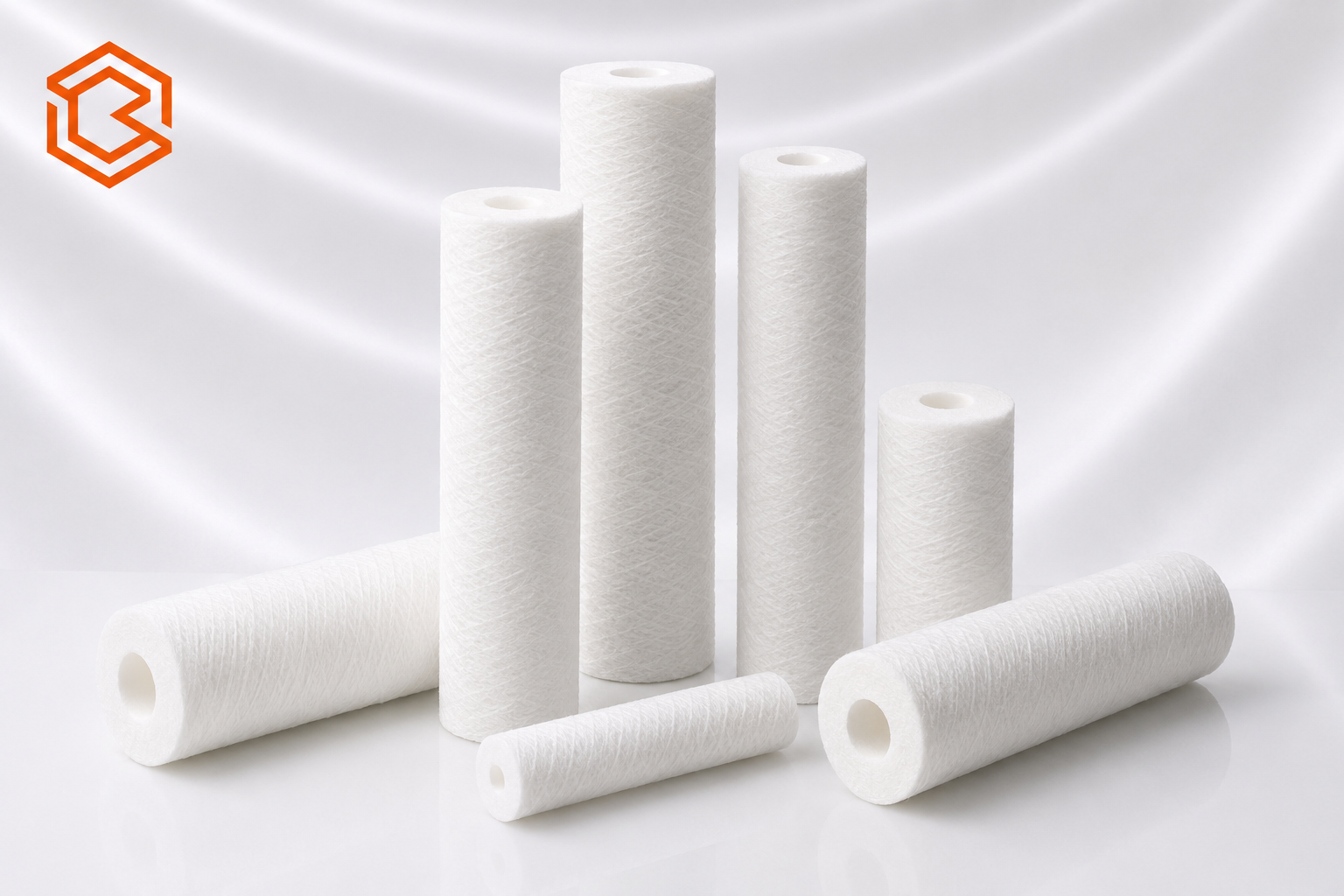
Sri Bharathi Tech manufactures and supplies Spun-Bonded Filter Cartridges from Ankleshwar, Gujarat, India, with grade, size and configuration selection based on the buyer’s process and equipment.
Operating principle
Spun-bonded cartridges are formed by depositing polypropylene fibres into a self-supporting depth structure. Sri Bharathi describes a true gradient density from the outer to the inner surface. Feed flows outside to inside: coarser voids encounter larger particles first and finer inner zones progressively retain smaller material.
Captured particles remain within the depth matrix while filtrate passes to the core. This distribution can provide useful dirt capacity and low initial pressure drop in general pre-filtration and clarification duties.
Media design
The construction uses 100% polypropylene fibre, continuously formed around a central moulded core or supplied in coreless versions. The process does not require binders, resins or lubricants, and the continuous fibre structure provides stable media performance under normal intended service.
One-piece constructions are available in lengths of 1016 mm and above. Exact diameter, core, end connection, rating type and operating limit must be matched to the housing and fluid.
What to evaluate
01
Broadly compatible material for many aqueous and chemical duties.
02
Free of surfactants, binders and adhesives.
03
Progressive outside-to-inside structure supports staged particle capture.
04
Construction can be selected around pressure and housing needs.
05
Standard, big-blue and larger diameters are listed.
06
Standard 10–40 inch and custom sizes are available.
Technical data
The specifications below provide a practical basis for product selection. Final grade and configuration are matched to the intended process conditions.
| Selection parameter | Product details | Engineering relevance |
|---|---|---|
| Material | 100% polypropylene fibres. | Confirm fluid, concentration and temperature compatibility. |
| Lengths | 10, 20, 30 and 40 inches; custom sizes available. | Match effective housing length. |
| Micron options | 0.5, 1, 5, 10, 20, 25, 50, 75 and 100 µm. | Confirm nominal/absolute basis and test method. |
| Outside diameters | 64 mm (2.5 in), 114 mm (4.5 in), 6 in and 8 in. | Select for housing clearance and required area. |
| Inside diameters | 25, 28 and 48 mm. | Match support core and end hardware. |
| Configurations | DOE and Code 7 (226 O-ring). | Confirm gasket/O-ring and seating geometry. |
| Construction length | One-piece lengths of 1016 mm and above are available. | Reduces joints; verify handling and housing fit. |
Process fit
Applications include food and beverages, pharmaceuticals, fine chemicals, magnetic coatings, petrochemicals, cosmetics, water treatment, metal finishing and electronics. Spun media is commonly evaluated as a prefilter before finer pleated cartridges or as a general particulate-removal element.
Questions engineers ask
The outer structure is more open and becomes finer inward, helping distribute solids rather than loading only the outside surface.
A core can provide extra mechanical support where differential pressure, temperature or handling demands warrant it. Confirm the actual cartridge limit.
No. It has broad compatibility, but concentration, temperature, exposure time and seals must be checked.
Sometimes for pre-filtration, but the two constructions differ in area, rating precision and loading behaviour. Trial data should guide substitution.
Continue specifying
Application support
Share your fluid, temperature, desired clarity, existing equipment and dimensions. Our team can then recommend a suitable construction and prepare a quotation.