
More area in a compact module
Stacked cells provide substantial filtration area, supporting throughput within a compact housing.
Modular filtration
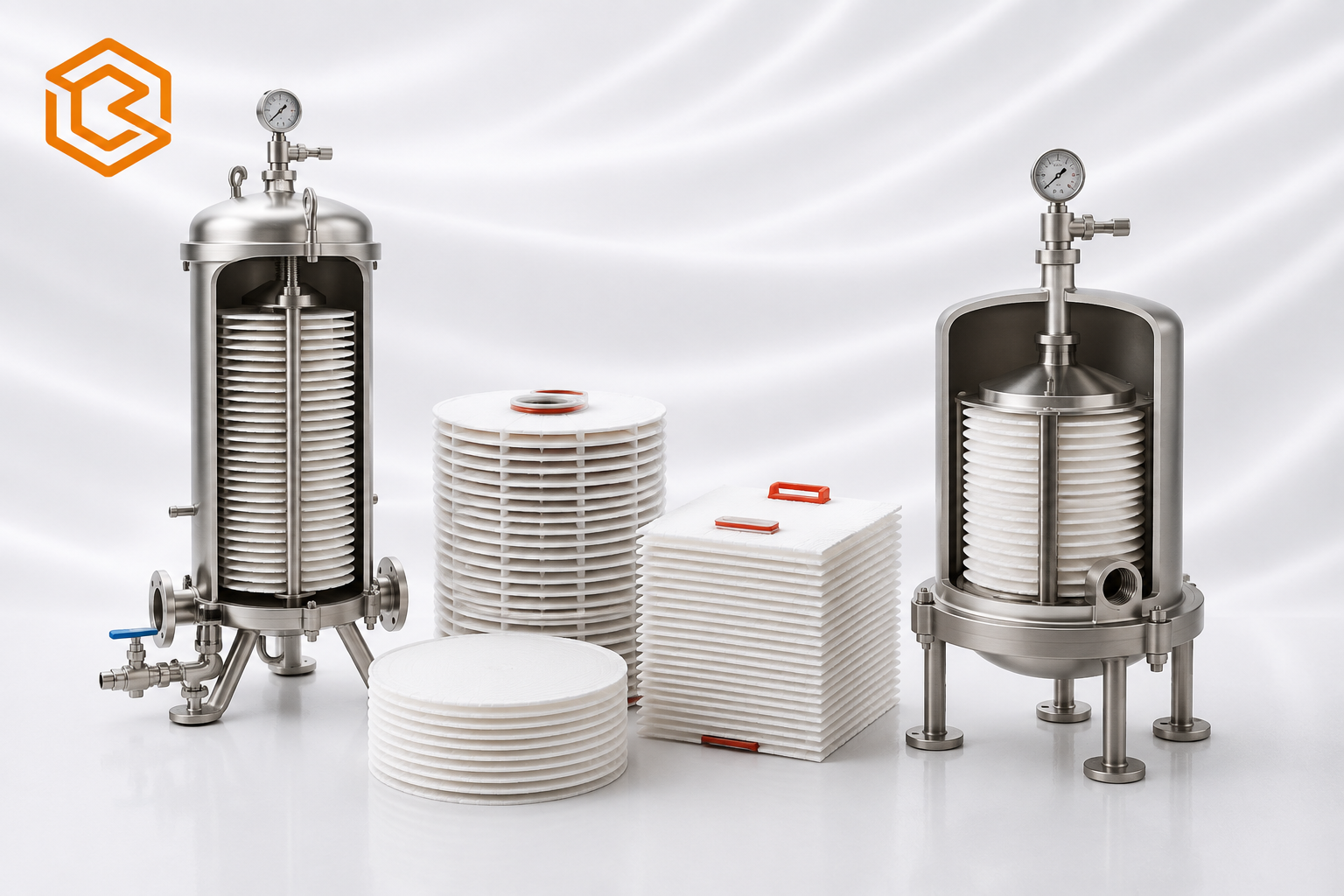
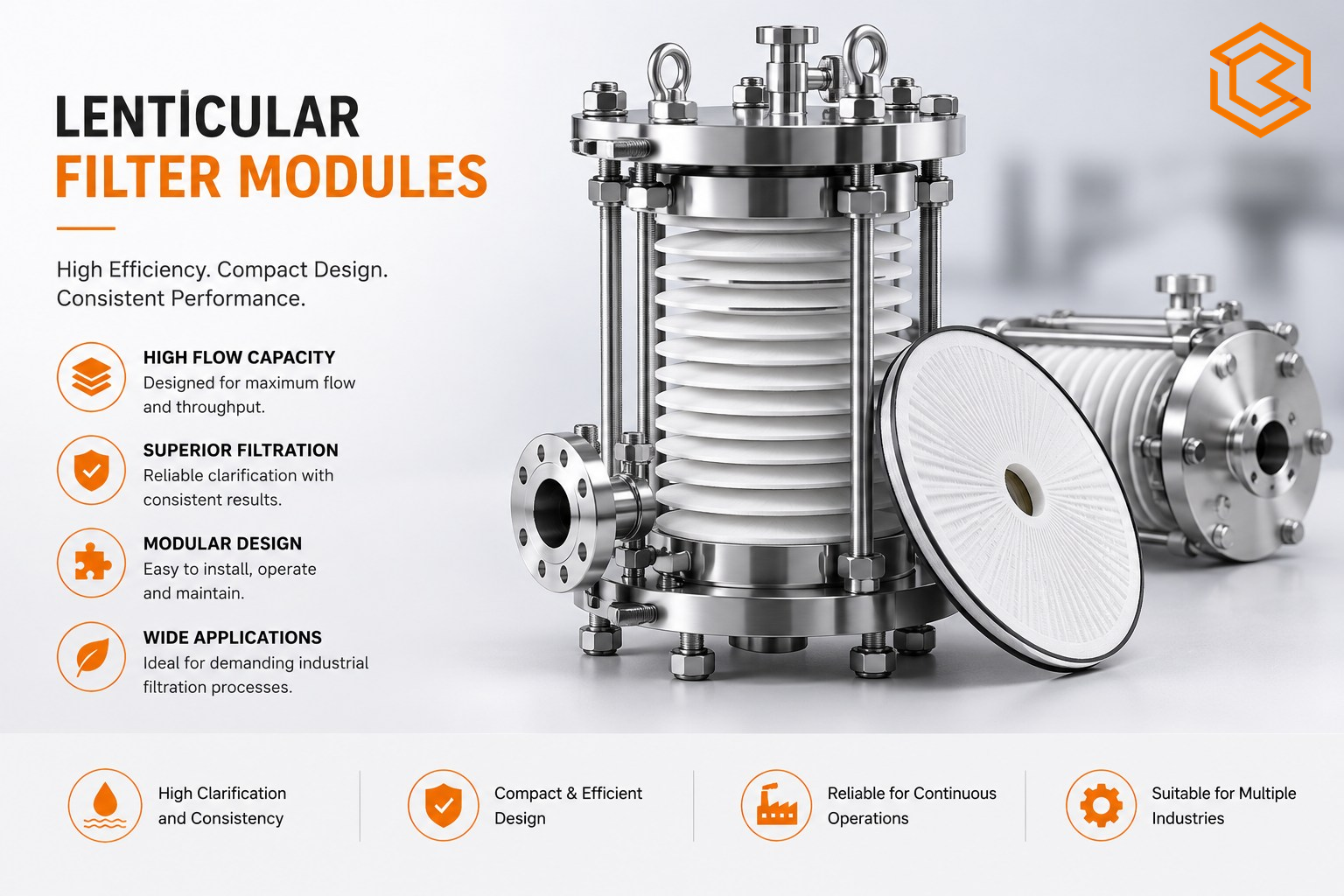
Sri Bharathi manufactures lenticular depth-filter systems with supported sheet stacks, compact filtration area, stable drainage and practical handling for process clarification.
Sri Bharathi Tech manufactures and supplies Lenticular Depth Filter Systems from Ankleshwar, Gujarat, India, with grade, size and configuration selection based on the buyer’s process and equipment.
Technical product information
Supported depth-filter sheets combine a large filtration area with internal drainage channels in a compact, enclosed module.
Inside the module
Liquid enters through the media faces. Suspended particles are retained within the depth-filter matrix.
Internal dividers support the sheets and provide channels that carry filtered liquid towards the centre.
Clean-side channels collect the filtrate at the central outlet, separating it from the incoming feed.
Confirm flow direction, differential-pressure and sanitation limits for the selected module. Backflushing suitability is configuration-specific.
Stacked cells provide substantial filtration area, supporting throughput within a compact housing.
The contained assembly can reduce open-product exposure and simplify media handling and changeovers.
Depth filtration can improve clarity and reduce the particulate load reaching downstream cartridges.
Operating principle
A lenticular module stacks annular depth-filter sheets around an internal drainage structure. Feed enters the housing, moves through the depth media and reaches clean-side channels that collect filtrate toward the central outlet. Multiple sheet layers provide substantial area within a sealed, compact assembly.
Compared with exposed plate-and-frame sheets, the enclosed module can simplify handling and reduce open-product exposure. It does not eliminate the need to control differential pressure, flow direction, venting, pre-wetting or sanitation.
Media design
Sri Bharathi describes modular/lenticular systems as piles of depth pads separated by an in-built drainage structure. Dividers support individual sheets, help resist deformation during heat treatment and hot sanitation, and create multiple flow channels. Rigid external clips assist module handling.
Specifications and material-of-construction options are application-dependent. Sheet grade, module diameter, cell count, gasket, housing connection and sanitation limits should be frozen in an approved specification.
What to evaluate
01
Reduces open handling compared with manually dressed sheet stacks.
02
Separators collect filtrate and support multi-directional flow.
03
Dividers provide mechanical support during processing and heat exposure.
04
Stacked annular sheets package useful depth-media area in a housing.
05
External clips help protect sheets during loading and unloading.
06
MOC and module specifications can be matched to compatible applications.
Technical presentation
Explore the migration from conventional sparkler pads to Sri Bharathi modular/lenticular filtration, including flow paths, handling, throughput and system advantages.
Technical data
The specifications below provide a practical basis for product selection. Final grade and configuration are matched to the intended process conditions.
| Selection parameter | Product details | Engineering relevance |
|---|---|---|
| Media format | Stacked annular depth-filter sheets. | Choose grade for clarification target and solids load. |
| Drainage | Built-in separators and clean-side channels. | Supports filtrate collection and sheet stability. |
| Module size / cells | Configured to suit the application and required filtration area. | Match housing, batch volume and required area. |
| Material of construction | Multiple material options are available. | Confirm plastics, seals and sheet materials for the process. |
| Heat treatment | Design addresses deformation during heat treatment/hot sanitation. | Request grade-specific cycle limits and validation. |
| Operating direction | Housing- and module-specific. | Incorrect assembly or flow risks bypass or damage. |
| Integrity / endpoint | Define by process and supplier data. | Trend pressure, flow and filtrate quality. |
Process fit
Lenticular filtration can be considered for beverage, food, gelatin, pharmaceutical intermediate and chemical clarification where enclosed depth media, manageable module handling and compact area are valued. It is often positioned after bulk solids removal and before finer cartridges.
Questions engineers ask
Both can use depth media, but a lenticular module encloses stacked annular sheets around drainage cells, while a sparkler filter uses individual pads or cloths on horizontal plates.
Some constructions are designed for compatible hot sanitation. Confirm the exact time, temperature, cycle count and fluid for the quoted module.
High incoming solids, insufficient prefiltration, viscous or cold feed, too-fine media, air binding or excessive initial flux can contribute.
They are depth filtration modules. A validated membrane may still be required where a downstream microbial-retention claim is needed.
Continue specifying
Application support
Share your fluid, temperature, desired clarity, existing equipment and dimensions. Our team can then recommend a suitable construction and prepare a quotation.