
01
Controlled yarn winding
Creates a rugged depth structure with graded flow pathways.
Filter cartridges
We manufacture controlled yarn-wound depth cartridges for economical particulate removal, high solids capacity and compatibility-led material selection.
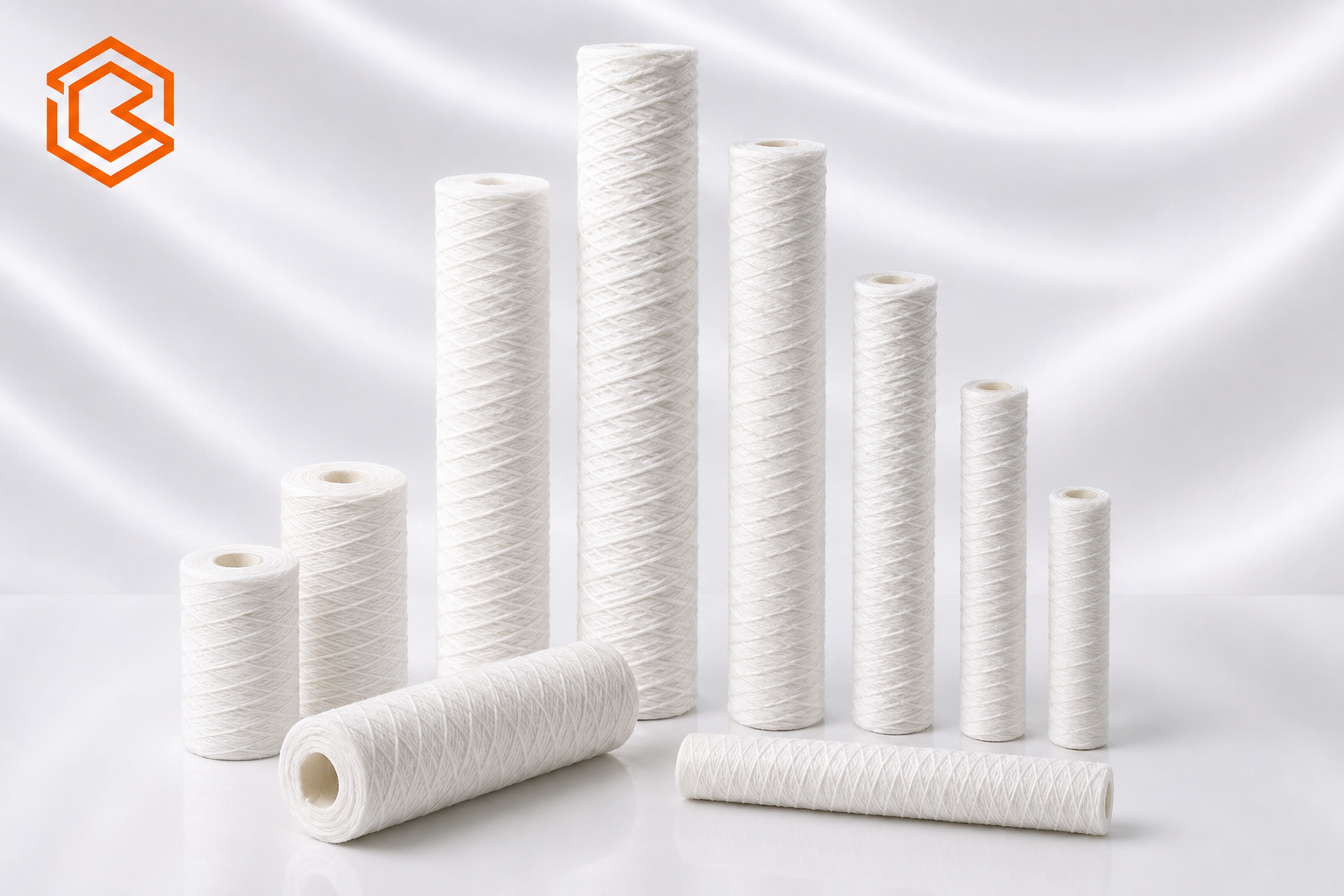
Sri Bharathi Tech manufactures and supplies Wound Filter Cartridges from Ankleshwar, Gujarat, India, with grade, size and configuration selection based on the buyer’s process and equipment.
Operating principle
Wound cartridges are made by continuously winding filtration yarn around a perforated core in a controlled pattern. The overlapping yarn creates tapered flow channels and a depth matrix. Feed moves from outside to inside, depositing larger particles in the outer zones while progressively finer pathways retain smaller material.
Winding tension, yarn type, core, density and pattern establish the filtration behaviour. A well-matched wound cartridge can offer robust dirt holding at economical cost in high-solids liquid duties.
Media design
Available constructions include polypropylene yarn with a polypropylene core and cotton yarn with a stainless-steel core. Raw materials are processed into controlled fibres and rovings before winding. Additional material combinations can be evaluated for specific requirements.
Core and yarn must both be chemically and thermally compatible. Cotton may suit selected oils, dilute acids, solvents and potable-liquid duties, while polypropylene is suited to many organic acids, oils, concentrated alkalis, water, solvents and electroplating solutions—always subject to compatibility review.
What to evaluate
01
Creates a rugged depth structure with graded flow pathways.
02
Depth loading supports particulate removal in demanding liquid services.
03
Available lengths extend from 10 to 60 inches.
04
PP/PP and cotton/stainless-steel constructions are listed.
05
Outside diameters range from 58 to 200 mm.
06
DOE and Code 7 configurations are available.
Technical data
The specifications below provide a practical basis for product selection. Final grade and configuration are matched to the intended process conditions.
| Selection parameter | Product details | Engineering relevance |
|---|---|---|
| Construction options | Polypropylene yarn/PP core; cotton yarn/stainless-steel core. | Select both yarn and core around the fluid and temperature. |
| Lengths | 10, 20, 30, 40 and 60 inches. | Confirm actual housing effective length. |
| Micron options | 0.5–100 µm. | Request rating basis and efficiency. |
| Outside diameter | 58–200 mm. | Supports standard and high-capacity housing formats. |
| Inside diameter | 25 mm. | Check core and seal arrangement. |
| Configurations | DOE and Code 7 (226 O-ring). | Match the cartridge socket and seal. |
| Operating limit | Specified by grade and operating conditions. | Confirm differential pressure, temperature and flow before use. |
Process fit
PP wound cartridges are suited to many organic acids, oils, concentrated alkalis, water, organic solvents and electroplating solutions. Cotton wound constructions serve selected vegetable oils, dilute acids, organic solvents, potable liquids and alkalis. Final material selection is based on full process compatibility.
Questions engineers ask
Yarn properties, winding pattern, tension and density create the depth pathways. The rating is defined by the applicable performance test method.
That combination may suit selected process fluids or temperatures where cotton is preferred and a strong corrosion-resistant core is appropriate.
They are generally treated as replaceable depth media. Validated reuse is difficult because solids lodge inside the winding.
Incompatible chemistry, excessive differential pressure, weak yarn, poor winding or incorrect flow can contribute. Use the specified direction and limits.
Continue specifying
Application support
Share your fluid, temperature, desired clarity, existing equipment and dimensions. Our team can then recommend a suitable construction and prepare a quotation.