
01
Fits horizontal plate filters
Pads are cut around plate OD, centre opening and flow-path requirements to support proper sealing.
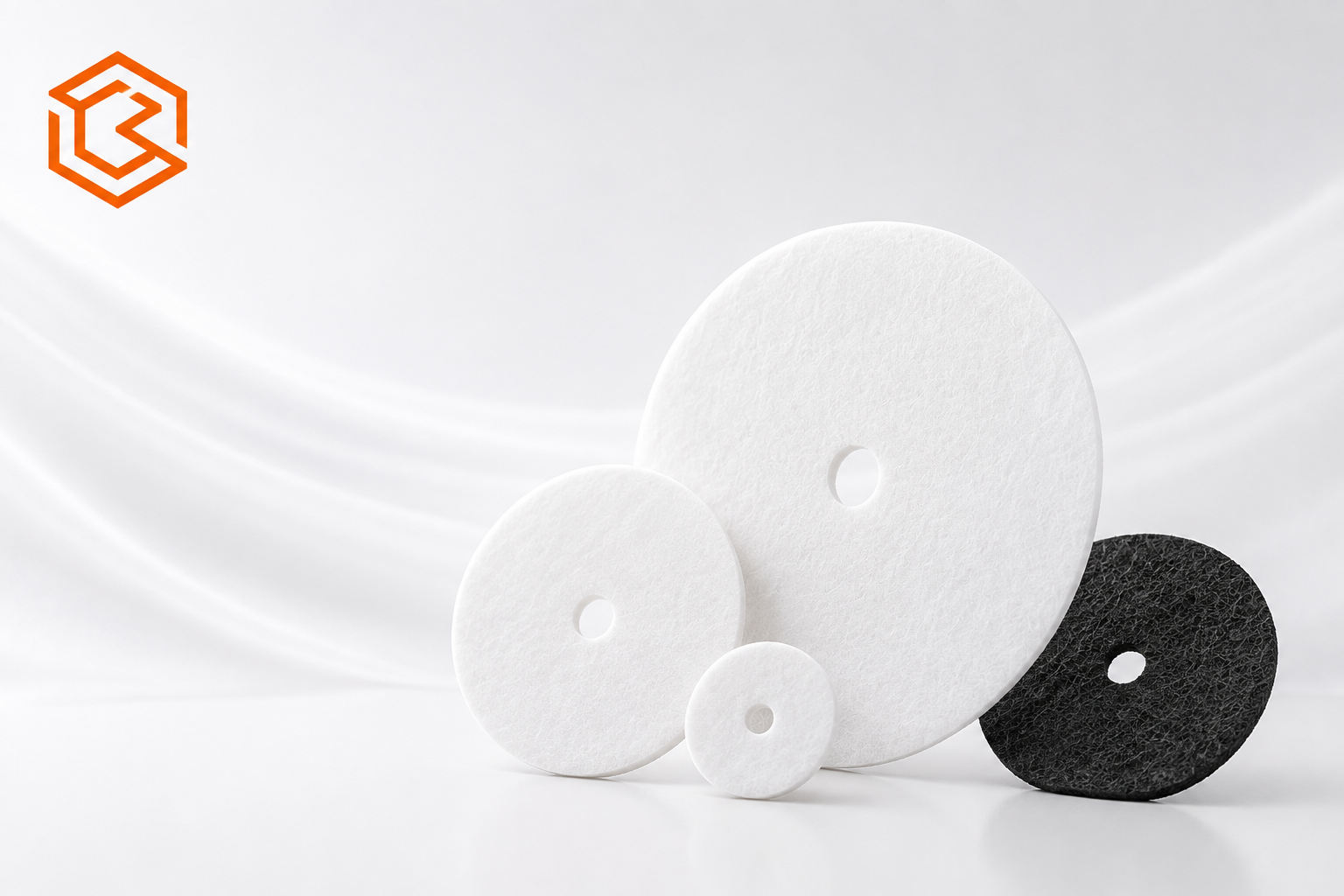
Filter pads
We manufacture cut media for horizontal plate sparkler filters, matched to plate geometry, fluid compatibility, solids loading, clarification targets and cycle economics.
Sri Bharathi Tech manufactures and supplies Sparkler Filter Pads from Ankleshwar, Gujarat, India, with grade, size and configuration selection based on the buyer’s process and equipment.
Operating principle
A horizontal plate sparkler filter contains stacked plates with perforated support screens. Feed enters the closed shell under pump pressure and is distributed across the plate stack. The supported pad or cloth retains solids while filtrate passes through the media, enters the central interlocking-cup channel and leaves the filter.
As deposited solids form a cake, resistance rises and flow commonly falls at constant pump conditions. The useful cycle ends when throughput, differential pressure or filtrate quality reaches the agreed limit. Correct pad diameter, centre-hole geometry, sealing and flow direction are essential to prevent bypass.
Media design
Sri Bharathi offers disposable and reusable sparkler media in woven and nonwoven constructions. Material options include polypropylene, nylon, cotton, polyester and specialty fabrics for specific duties. Heat-sealed or reinforced edges may be used to improve durability.
Media selection should account for chemical compatibility, temperature, slurry abrasiveness, required cake release, cleanability and the risk of fibre migration. Cellulose pulp pads may also be cut for supported sparkler duties where depth clarification is required.
What to evaluate
01
Pads are cut around plate OD, centre opening and flow-path requirements to support proper sealing.
02
The pad retains particles directly and supports the developing cake during batch filtration.
03
Woven, nonwoven and cellulose-based options allow compatibility and retention to be balanced.
04
The choice depends on validation, cleaning practicality, economics and contamination risk.
05
Heat sealing or reinforcement can improve handling life on suitable synthetic constructions.
06
Final dimensions should follow an approved drawing or physical sample to prevent bypass.
Technical data
The specifications below provide a practical basis for product selection. Final grade and configuration are matched to the intended process conditions.
| Selection parameter | Product details | Engineering relevance |
|---|---|---|
| Material options | Polypropylene, nylon, cotton, polyester and specialty fabrics. | Match media chemistry and temperature to the process fluid. |
| Construction | Woven and nonwoven; disposable and reusable options are available. | Controls flow, cake release, cleanability and particle retention. |
| Dimensions | Made to equipment geometry; submit OD, ID, holes/notches and thickness. | Correct fit protects against edge or centre bypass. |
| Operating limit | Grade-specific; specified for each selected grade. | Confirm maximum differential pressure and temperature for the selected medium. |
| Retention | Application- and media-specific. | Validate with the real suspension; woven cloth and depth pads behave differently. |
| Change-out trigger | Pressure, falling flow, batch endpoint or filtrate-quality limit. | A defined endpoint improves repeatability and protects equipment. |
Process fit
Sparkler filter pads are used extensively in pharmaceutical and chemical processing and can be evaluated for food, beverage, oil and gelatin clarification when material and document requirements are met. They are typically chosen for batch clarification, catalyst or particulate recovery, polishing and protection of downstream filters.
Questions engineers ask
The retained solids form an increasingly resistant cake. Flow falls unless the pump raises differential pressure; operation should remain within equipment and media limits.
Not automatically. They may differ in thickness, compressibility, sealing, retention, cake release and pressure-drop behaviour.
Incorrect OD or centre-hole dimensions, damaged media, poor plate alignment, inadequate sealing, folds or an incorrect assembly sequence can allow unfiltered paths.
That depends on the media and process. If pre-wetting is used, the wetting fluid, volume and disposal or recovery procedure should be defined in the operating method.
Continue specifying
Application support
Share your fluid, temperature, desired clarity, existing equipment and dimensions. Our team can then recommend a suitable construction and prepare a quotation.