
01
Sparkler filter pads
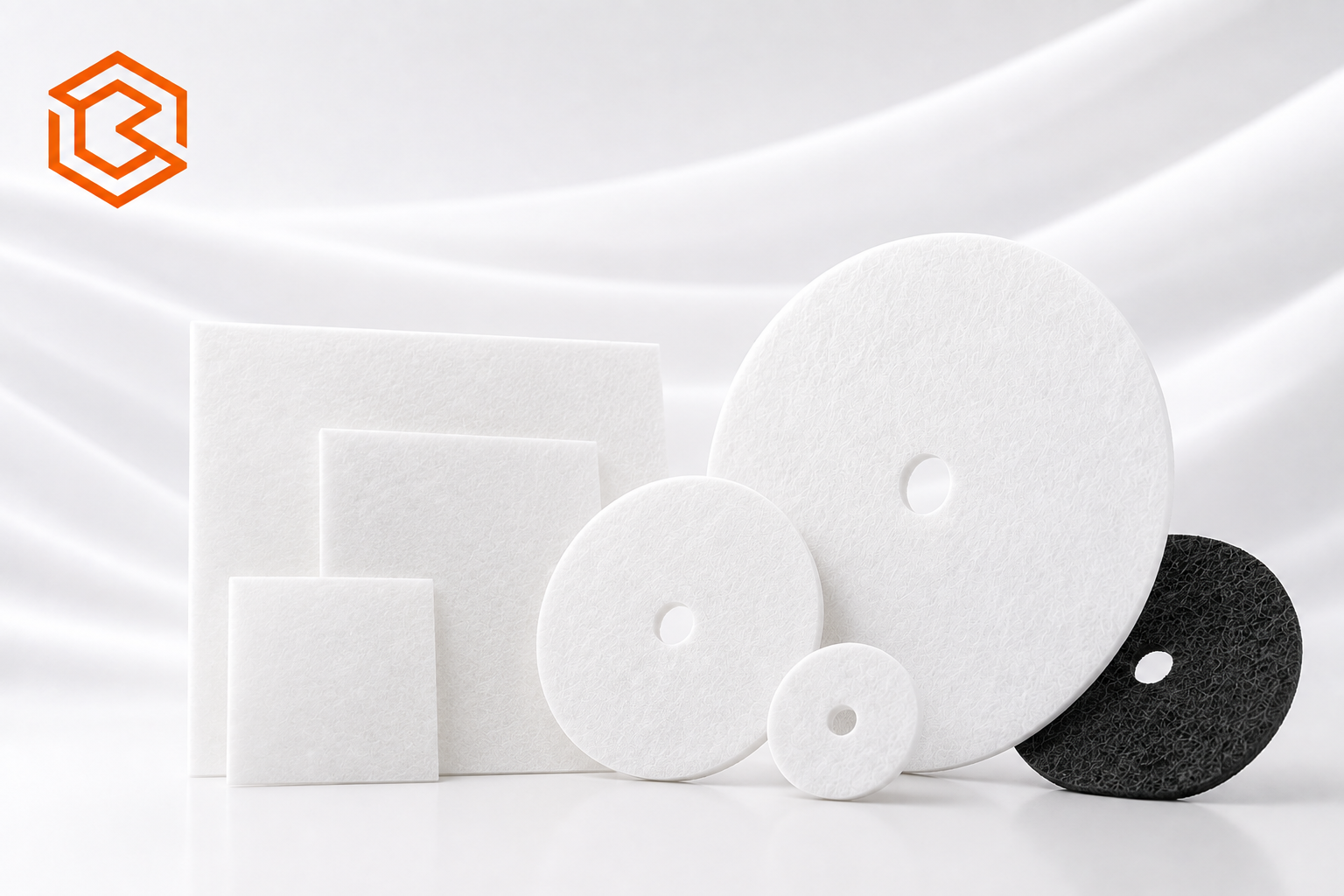
Circular pads and fabric media cut for horizontal plate sparkler filters, selected around plate geometry and process duty.
Sparkler filter pads →Core product category
Sri Bharathi manufactures pulp filter pads, sparkler filter pads and activated carbon filter pads for clarification, polishing and particulate-retention duties across industrial liquid processes.
Depth filtration explained
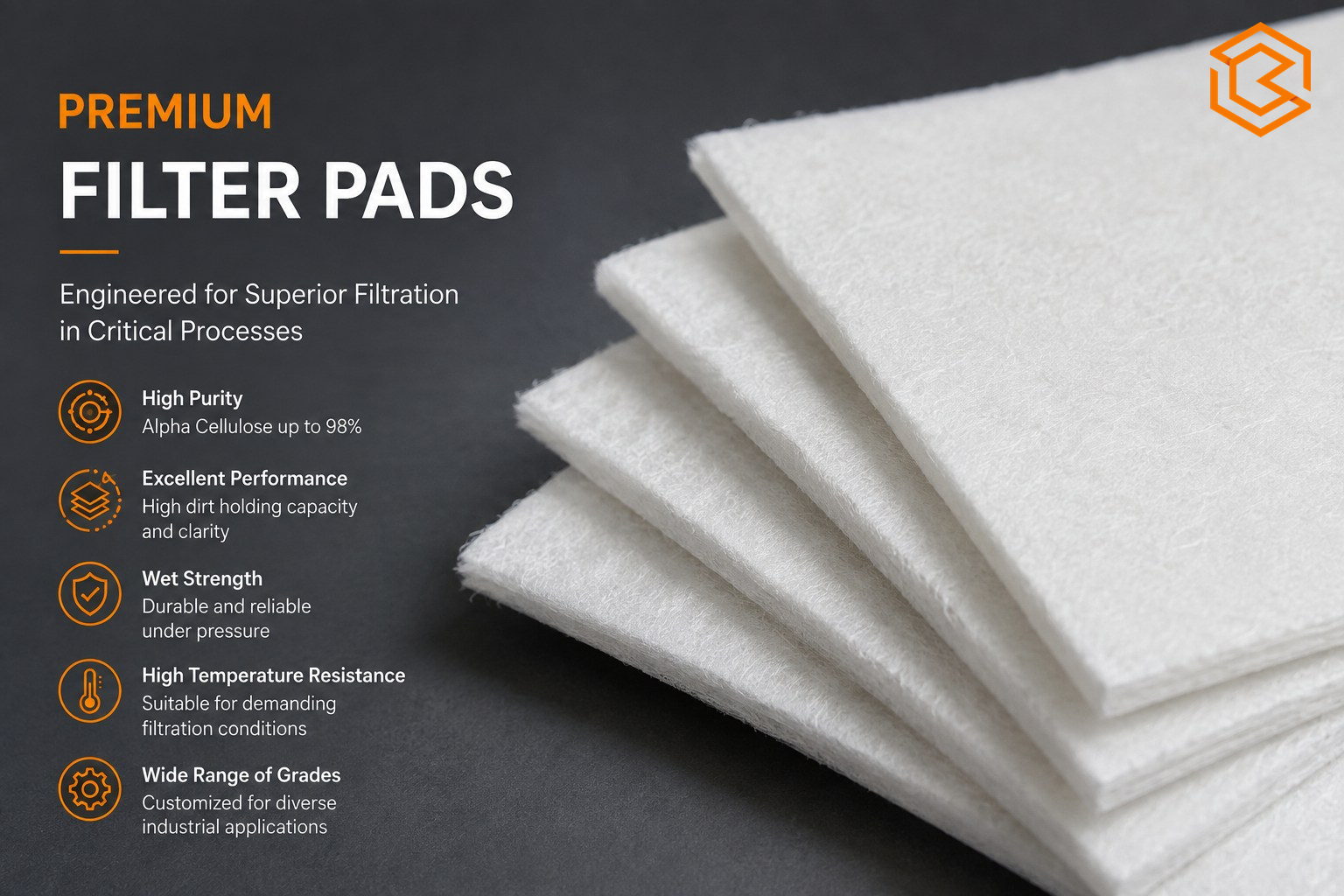
An industrial filter pad is a porous sheet or cut shape placed in a filter press, sparkler assembly or other supported filtration arrangement. Unlike a simple screen, a depth pad presents a tortuous network of fibre passages. Particles are intercepted within this matrix and, depending on the duty, at the upstream face as a filter cake develops.
Cellulose filtration media can combine clarification, solids-holding capacity and manageable flow resistance. The correct result depends on the complete grade—not on thickness or GSM alone. Fibre furnish, formation, density, porosity, impregnation, wet strength and surface condition all affect performance.
Alpha cellulose is the high-molecular-weight, alkali-insoluble portion of cellulose. Higher-purity furnish can reduce non-cellulosic extractables and improve consistency for sensitive applications, but purity alone does not define filtration efficiency. Grade-specific alpha-cellulose values and test methods are available through technical enquiry.
Product range
01
Circular pads and fabric media cut for horizontal plate sparkler filters, selected around plate geometry and process duty.
Sparkler filter pads →02
Virgin-pulp depth sheets for rough, normal, clarifying, polishing, fine and premium filtration categories.
Pulp filter pads →03
Carbon-impregnated media combining filtration with adsorption for compatible colour and odour reduction duties.
Activated carbon pads →04
Heat-resistant media designed for compatible liquids in the 180–250 °C operating range.
High-temperature pads →05
Virgin wood-pulp papers for fast and coarse filtration with grade-dependent wet-strength treatment.
Filter papers →06
Stacked depth sheets within enclosed modular constructions and internal drainage support.
Lenticular filters →Technical presentation
Review the media families, pulp types, construction differences, grade tables, high-temperature pads and activated carbon pads in this 10-page presentation.
Specification discipline
| Selection parameter | Product details | Engineering relevance |
|---|---|---|
| Fibre composition | Fibre options include virgin wood pulp, cotton pulp and hybrid pulp. | Influences purity, strength, compatibility, formation and depth structure. |
| Thickness | Grade- and application-specific; confirm by sample or approved drawing. | Affects bed depth, compressed fit and solids-holding volume. |
| Basis weight (GSM) | Grade-specific GSM values and tolerances are available for product selection. | Indicates mass per unit area but does not independently define retention. |
| Porosity / flow | Monitored during manufacture; request the relevant test method and limit. | Links permeability to pressure drop and cycle time. |
| Wet and dry strength | Bursting factor and wet-strength behaviour are monitored on applicable grades. | Reduces risk of tearing or media collapse during handling and filtration. |
| Particle retention | Define using process trials and an agreed clarity or particle criterion. | Depth media performance depends on the actual suspension and operating conditions. |
| Dimensions | Customisation is offered subject to drawing and equipment review. | Correct OD, ID, holes and edge geometry prevent bypass. |
| Temperature / chemistry | Confirm for each media and fluid; high-temperature pads have a dedicated operating range. | Avoids swelling, strength loss, extractables or premature failure. |
Selection sequence
1
Record fluid chemistry, temperature, viscosity, solids concentration and particle distribution.
2
State whether the duty is rough filtration, clarification, polishing, colour reduction or protection of downstream media.
3
Provide filter type, plate diameter, pad drawing, flow direction, seals and available differential pressure.
4
Compare initial flow, pressure rise, filtrate clarity, cycle time, yield loss and pad integrity.
5
Freeze the tested construction, dimensions, acceptance criteria, packing and document requirements.
6
Trend pressure, throughput and clarity so change-out decisions are based on process performance.
Common questions
No. GSM is basis weight, not a direct pore-size or micron rating. Fibre furnish, formation, density, thickness and surface treatment also influence retention and flow.
Surface filtration retains most solids at a plane or growing cake. Depth filtration captures particles through a three-dimensional fibre matrix, often providing greater solids capacity for clarification duties.
Not reliably. Changes in viscosity, temperature, particle distribution, pre-treatment and solids concentration can materially change pressure rise and clarity.
Dry strength supports converting and handling. Wet strength helps the pad retain integrity after saturation and under process pressure.
Ask for the declared value, test method and grade-specific certificate. Treat alpha-cellulose level as one material-quality input, not a complete filtration-performance claim.
Application support
Send the liquid, temperature, viscosity, solids load, desired clarity, filter-press details and current pad dimensions. Samples or trial quantities can then be discussed for the specific application.