
01
All-PP construction
Media and structural components are made from polypropylene.
Filter cartridges
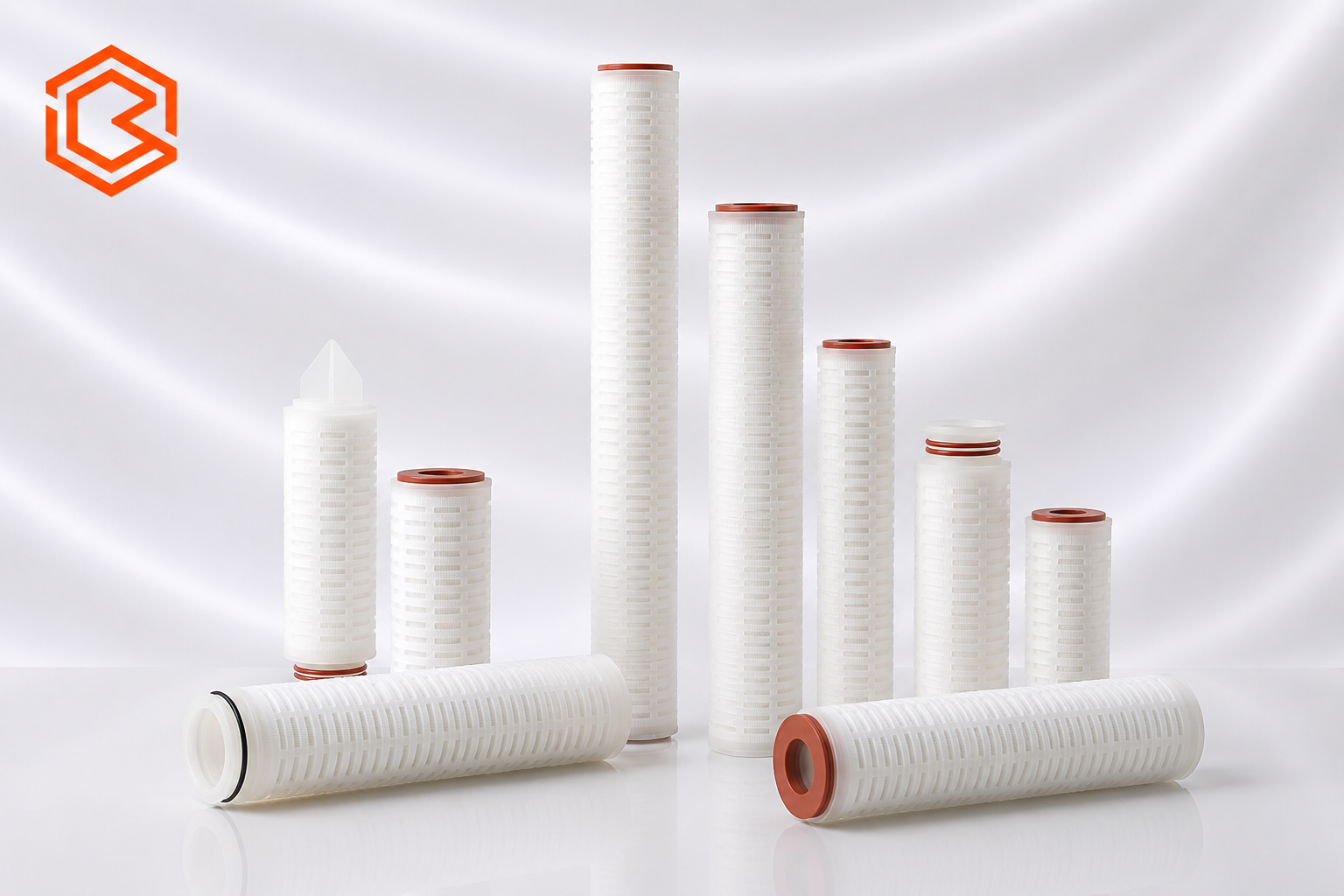
We manufacture all-polypropylene pleated cartridges with gradient-density microfiber media, combining defined retention options, filtration area and contaminant capacity.
Sri Bharathi Tech manufactures and supplies Polypropylene Pleated Filter Cartridges from Ankleshwar, Gujarat, India, with grade, size and configuration selection based on the buyer’s process and equipment.
Operating principle
PP pleated cartridges arrange microfiber media in folds around a central core, creating more filtration area than a flat cylinder of the same length. Sri Bharathi describes a gradient-density structure that is more open on the outside and finer toward the inside, allowing larger particles to be captured upstream while finer layers perform final retention.
Flow passes through the pleated pack to the core and then to the clean side of the housing. The greater area can lower initial flux per unit area and increase useful throughput, subject to media rating, solids load and differential-pressure limits.
Media design
The construction is all polypropylene with a robust outer cage and thermally welded assembly, avoiding adhesives in the fluid path. The range includes nominal and absolute options, gradient-density microfiber media and a surface area above 0.5 m².
Polypropylene offers broad compatibility, but every fluid, temperature and concentration should be checked. Seal materials and sanitisation exposure also require confirmation.
What to evaluate
01
Media and structural components are made from polypropylene.
02
Open-to-fine layers distribute captured solids through the media structure.
03
Surface area is more than 0.5 m², depending on configuration.
04
The assembly is thermally welded rather than adhesively bonded.
05
DOE, 226 and 222 O-ring styles are available in flat or fin variants.
06
Applications span pharmaceuticals, beverages, water, gelatin and fine chemicals.
Technical data
The specifications below provide a practical basis for product selection. Final grade and configuration are matched to the intended process conditions.
| Selection parameter | Product details | Engineering relevance |
|---|---|---|
| Lengths | 10, 20, 30 and 40 inches. | Match housing length and stacking requirements. |
| Micron options | 0.1, 0.2, 0.45 and 1–50 µm, depending on grade. | Confirm exact grade, rating type, efficiency and test method. |
| Outside diameter | 69 mm. | Verify clearance within the housing. |
| Inside diameter | 28 mm. | Relevant to core geometry and flow path. |
| Surface area | More than 0.5 m². | Exact value depends on length and pleat pack. |
| End configurations | DOE; Code 7F/7S (226); Code 3F/3S (222). | Match socket, locking and seal arrangement. |
| Rating type | Nominal and absolute options are available. | Request the efficiency definition and validation data for the selected grade. |
Process fit
Applications include fine chemicals, pharmaceuticals, deionised water, RO pre-filtration, ophthalmic liquids, biological fluids, oral drugs, photographic processes, emulsions, gelatin and beverages including wine, beer, fruit juice and alcohol.
Questions engineers ask
No sterilising-grade claim should be inferred from micron size alone. That requires grade-specific bacterial-retention validation and controlled manufacturing documentation.
It can distribute particles by size through the structure, improving contaminant capacity compared with a single uniform fine layer.
Code 7 uses a 226 O-ring connection; Code 3 uses 222. Flat or fin-end variants affect housing fit and orientation.
Gelatin is an established application. The grade must still be selected around temperature, viscosity, preclarification and target retention.
Continue specifying
Application support
Share your fluid, temperature, desired clarity, existing equipment and dimensions. Our team can then recommend a suitable construction and prepare a quotation.